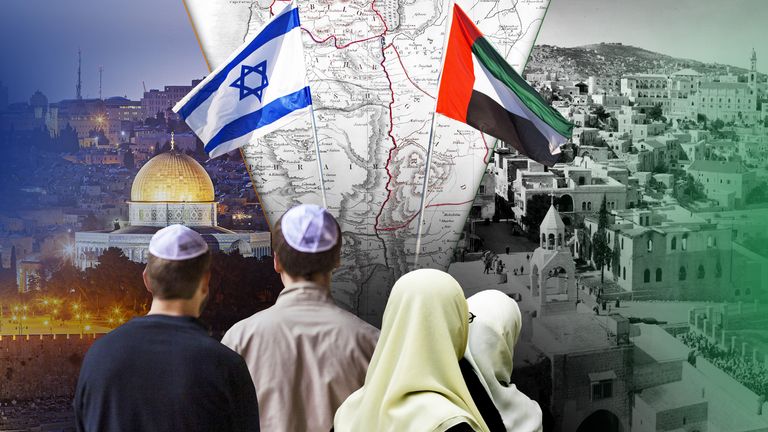
DISCLAIMER: This is an informational article and is not biased towards any side.
The conflict between the countries of Israel and Palestine has been ongoing for hundreds of years.
In the late 1800s the Jewish people were facing lots of antisemitism and discrimination in Europe. Jewish thinker Theodor Herzl wrote Der Judenstaat (The Jewish State). This political pamphlet argues that Jewish people need their own sovereign Jewish state. Herzl explained that Jewish people could not escape antisemitism by assimilating themselves into Europe.
The start of Zionism
Around the 1880s to 1900s, small groups of Jewish immigrants migrated to Palestine. They would start buying land and farming. At first most Palestinians did not see Zionism, the establishment of a Jewish nation, as a major threat, as it was just Jewish people finding refuge in a foreign land.
In 1897, the first Zionist conference would be held in Basel, Switzerland. The goal of this conference was to create a Jewish homeland in Palestine with international support. As Jewish immigration increased (especially from Eastern Europe), Palestinians began to notice demographic and cultural changes. Many localists saw the Zionist writings, like the ones written by Herzl, and they saw this as a plan to displace or politically dominate them.
The british mandate
In 1917 the British would enter the British Mandate period (1917-1947). The Balfour Declaration (1917) would express the British support for a “national home for the Jewish” within Palestine. The rates of Jewish immigration during the 1930s and 1940s heavily increased to escape Nazi persecution; as a result, Arab opposition understandably grew, and conflicts began to rise.
The Holocaust (1940-1945)
The Holocaust killed around 6 million Jewish people, which would lead to sympathy and global support for Zionism. During this time, Arabs sympathized with the Jewish people but did not want mass immigration into Palestine. The Arabs believed that a mass immigration of Jewish people to Palestine would lead to the loss of the Palestinian land and independence. They believed the West (Europe) was solving a European crime at the expense of the Arabs. In the end, the UN decided to split Palestine into a Jewish and Arab state. The Arabs rejected this plan, while the Israeli leaders accepted it.
In 1948 the Arab-Israeli War happened. In May of 1948, Israel declared their independence. Neighboring Arab countries would then invade (Egypt, Jordan, Syria, Iraq, and Lebanon). Israel survived and then expanded further than the UN originally planned. About 750,000 fled or were expelled from their homes.
From the 1950s to the 1960s, Palestinian refugees lived in refugee camps across the Middle East, and many of these people were still hoping to return home. In 1964, the Palestine Liberation Organization (PLO) was founded, aiming to liberate Palestine (at first by armed struggle).
The Six-Day War (1967)
Israel fought Egypt, Jordan, and Syria. Israel captured the West Bank, Gaza, East Jerusalem, the Sinai Peninsula, and the Golan Heights. This brought over 1 million more Palestinians under Israeli military rule. The UN called for Israel to withdraw in exchange for peace (Resolution 242), but both sides disagreed on the terms.
1970s–1980s: Wars and Peace Efforts
1973 Yom Kippur War: Egypt and Syria attacked; Israel held its ground. Later, Egypt made peace with Israel (Camp David Accords, 1979), regaining the Sinai. But no Palestinian state emerged—Palestinians felt abandoned. The PLO carried out attacks against Israel and was expelled from Jordan (1970) and later Lebanon (1982).
Around 1987, Palestinians in the West Bank and Gaza began an uprising (the First Intifada). They would hold strikes, protests, boycotts, and some violence. Israel would deploy the military to suppress this uprising. This would lead to thousands of Palestinians being arrested, hurt, or even killed. Daily life was disrupted, schools and universities were shut down for periods of time, Palestinians did not go to work, and many roads leading to hospitals were blocked off by the Israeli military.
2000’s
In the early 2000s the second uprising began (the Second Intifada). This second uprising was much more gruesome. Militants from groups like Hamas, Islamic Jihad, and Fatah’s al-Aqsa Martyrs’ Brigades carried out suicide bombings on buses, cafes, nightclubs, and markets inside Israel. Militants used rifles, roadside bombs, and later small rockets (from Gaza). As a result, Israel would send tanks, drones, and helicopters against the militants. Israel would aim to kill key militant leaders. For example, Hamas leaders Sheikh Ahmed Yassin and Abdel Aziz al-Rantisi. In the end thousands of Palestinians were killed, tens of thousands were injured, and the economy was in shambles. Around a thousand Israelis were killed, and now they live in constant fear of bombings.
In 2005, Israel withdrew from Gaza (but kept control of its borders and airspace). In 2006, Hamas won elections and then seized full control of Gaza in 2007. Since then, Gaza has been under blockade by Israel (and Egypt). Repeated wars between Israel and Hamas (2008, 2012, 2014, 2021, 2023–24), causing massive destruction in Gaza and rocket fire into Israel.
On January 15, 2025, negotiators from the U.S., Egypt, and Qatar finalized a three-phase ceasefire proposal. This six-week truce would begin on January 19, 2025; Israeli hostages would be released in exchange for Palestinian prisoners, and there would be a humanitarian and reconstruction phase. On January 19, 2025, hostages began to be exchanged. Israel reopened the Netzarim Corridor to allow Gazans to return north.
On February 10, Hamas suspended scheduled hostage releases, citing Israeli ceasefire violations, including continued airstrikes and delayed resettlement of displaced people. From February 13 to February 22, after negotiations continued, Hamas resumed hostage releases. On February 22, six Israeli hostages were released, but Israel delayed its release of 600 Palestinian prisoners, citing propaganda concerns. On February 20th, Israel received 4 deceased hostages, and on February 22nd, they received 6 live hostages. In return, Israel returned 300 to 400 live Palestinian prisoners.
From March 2nd to the 17th, a fragile informal truce still remained, but it would quickly spiral out of hand as Israel imposed a new blockade on humanitarian aid and electricity. On March 18th Israel would carry out a surprise airstrike, killing over 400 Palestinians.
As of August 18, Hamas has approved a new ceasefire plan for a 60-day truce and the release of hostages and is now waiting for Israel’s response. A major humanitarian crisis is occurring in Gaza, as there is a rapidly worsening “man-made famine” that has taken the lives of 263 people, which include 112 children.
How to help
A way to support the people in Gaza is through a website called help.rescue.org. The IRC and its partners will match all donations up to $2,250,000.

 The Blindspot